
Jun 29, 2026
Who Is Accountable When the AI Gets It Wrong?

The Problem We Keep Hearing About
EDOs are cautious by necessity. A mistake in a council report, a grant application, or a community economic profile carries real consequences – reputational, financial, and political. When AI enters that picture, a reasonable question follows immediately: if the tool gets something wrong, who owns it?
“If the AI produces something wrong, is that our problem or the vendor’s?”
Under current Canadian frameworks, it’s yours.
Accountability follows the organization that deploys and uses the tool, not the vendor that built it. That means your EDO is responsible for the accuracy of AI-generated content in council reports, grant applications, and investment packages, regardless of where the error originated (D-TRUST).
There’s a compounding risk called automation bias. When staff consistently follow AI outputs without critical review, especially under time pressure, errors go unchallenged and compound quietly. This is most common in capacity-constrained teams that most EDOs operate (BDO Canada).
One-third of Canadian municipalities currently have no formal AI governance guidelines (University of Toronto, School of Cities). That’s not a technology gap. It’s an accountability gap – and it’s the kind that becomes visible only after something goes wrong.
How We Solve It
KnowledgeFlow™ is built around a core principle: every output should be auditable and defensible.
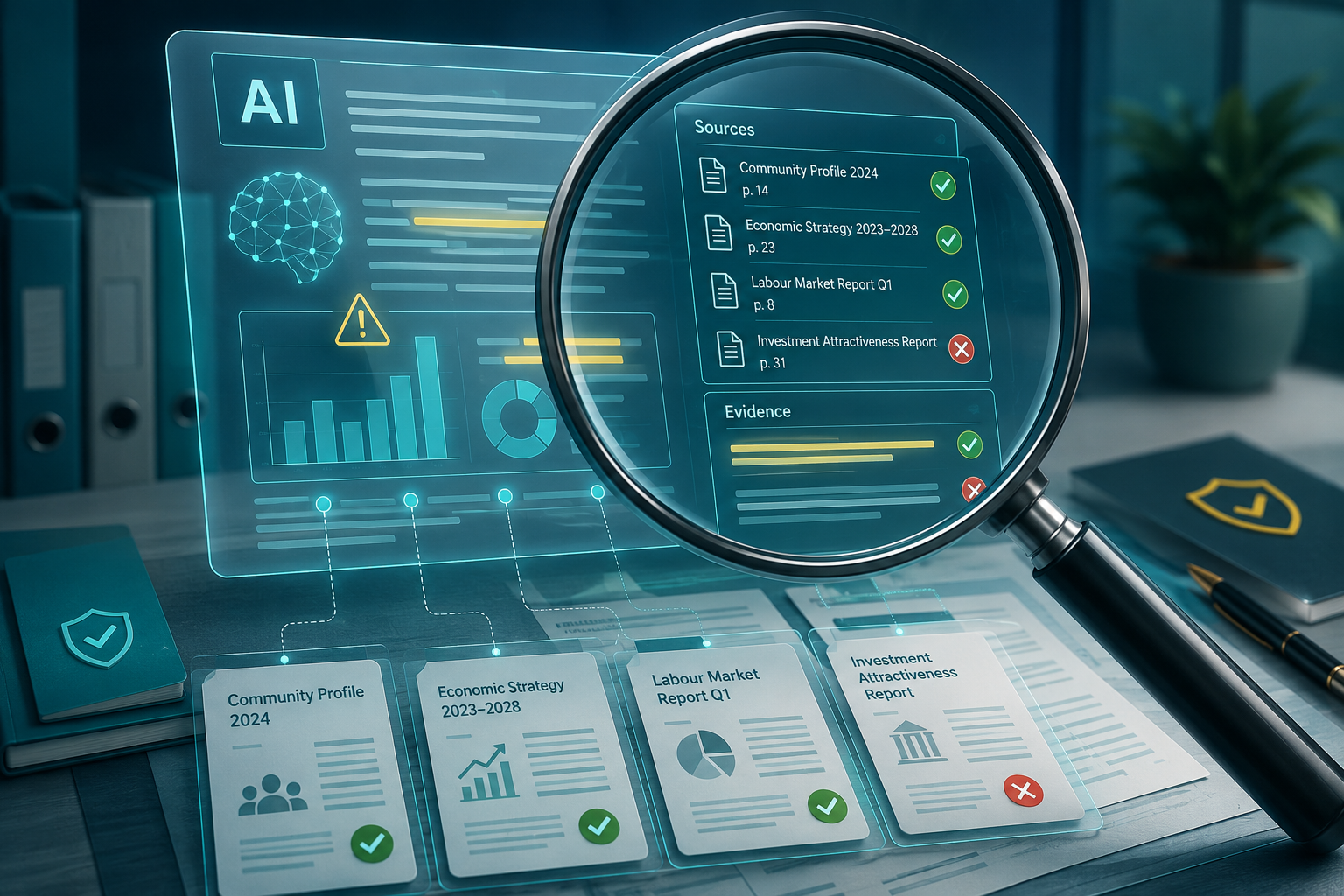
Unlike general-purpose AI tools that generate responses from broad training data, KnowledgeFlow uses Retrieval-Augmented Generation (RAG) to ground every response in your own verified documents: your strategies, bylaws, community profiles, past reports, and program guidelines. Every answer cites its source and links it to your internal data source that can be easily verified.
That matters practically. When a council member asks where a number came from, you can show them. When an auditor reviews a grant application, the AI-assisted content is traceable.
Beyond the technology, Qatalyst builds governance into the deployment itself. Our five-phase process includes establishing clear oversight protocols before go-live: who reviews AI outputs, who has authority to override them, and what the escalation path looks like when something needs a human decision.
We start by understanding your world before touching any technology. Every component we deploy maps to a real need in your office:
- Situational Assessment – to understand your goals, challenges, and current capabilities;
- Strategy Development – we validate priorities, define your AI ambition and build a prioritized portfolio of use cases;
- Technology Deployment – we establish your private Azure environment, then build, adapt, and deploy the KnowledgeFlow™;
- Implementation Support – we align roles and workflows, establish governance and risk guardrails, and deliver practical staff training; and finally,
- Customer Success – we follow up to support continuing use, assess the impact of AI adoption, and review improvements at the system and user level.
You receive hands-on training that builds confidence – not just how to use the tools, but how to apply critical judgment when reviewing what the tools produce.
The federal Treasury Board’s Directive on Automated Decision-Making sets the benchmark for accountability in AI deployment – transparency, legality, and human oversight (Button). We design our deployments to meet that standard, even for organizations that aren’t federally bound. When your council asks how you’re governing this, you’ll have a clear, documented answer.
Interested in Learning More?
Governance shouldn’t be an afterthought in your AI adoption. If you’d like to understand how KnowledgeFlow handles accountability – and how we build oversight into every deployment – we’d like to hear from you.
Contact us at qatalyst.ca/contact
Qatalyst is a Canadian management consulting firm specializing in AI-enhanced solutions for public sector and economic development organizations. We partner with Leading AI to deliver KnowledgeFlow – a secure, private AI platform deployed within your own cloud environment.